A couple of weeks ago I was in Chapananga village for the dedication of a new church building. Music and choirs are a big part of any special church function. This day was no exception. I was particularly impressed with one man’s innovation in creating a special drum set. It consisted of two traditional goat skin drums, bottle caps and my favorite piece, a bicycle bell. He played with some other drummers as the youth sang and danced.
See the video Chapananga Drums on YouTubeTuesday, February 2, 2010


Wednesday, December 23, 2009
I never thought to mention that ...
There was a fight not long after church last week. We were busy decorating our Christmas tree as a family when one of the neighbor boys came to get Caleb because there was a fight going on. Caleb came back quickly to report that one of the boys was bleeding from a cut that he had received. I went out to find the boys were all sons of my gardener. One of them was bleeding from a deep cut just below his eyebrow. I later learned that the boys were arguing about a football (soccer) match and one head butted the other causing the cut.
When we arrived home, I had Sete come in the house and I explained to him about his stitches. I explained what stitches are, that it is important to keep them clean, that the doctor said we could remove the bandage after two days and what the ibuprofen that he needed to take would do.
On Tuesday Sete returned to have the bandage removed. As I removed it and cleaned around the area, I began to explain again the need to keep it clean and that the swelling would go down. Suddenly Sete slumped forward into my arms. He had fainted. We grabbed a chair and had him sit for a while and drink something. As he returned to normal, I asked what had happened. He said that his heart had been racing. After a little more talking, we learned that he had been afraid. His heart was racing with fear that he would die. With all the explanation I had given him, I never thought to mention that he would not die! The rest of the family quickly assembled around him to show off scars of past stitches and give testimony to the fact that they are still alive (all of us but Faith have had stitches somewhere).
I am constantly amazed at the how we can take simple things like knowledge for granted. What many of us consider common knowledge is not understood by many in this world that have not had the benefit of a good education.
Have a great Christmas and while you’re at it, thank God for your education.
Tuesday, December 1, 2009
Lookin for Fuel
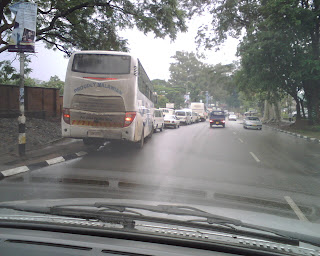
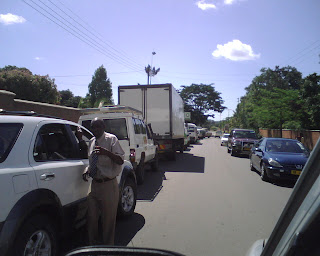
Malawi has had a fuel shortage for a few weeks now. We had one earlier in the year, but it was nothing like the present. It is only recently that the government has come out to say that it is being caused by a shortage of foreign currency. I don’t understand the economics of it enough to explain the problem or the solution. Put simply, I believe that we are importing more than exporting to the point that we can’t pay for basic needs like fuel. The government has made various statements including one encouraging Malawians to not import “luxury items,” such as cars, during this time as it worsens the problem.


Thursday, November 26, 2009
Thanksgiving Turkey
Thanksgiving has been one of those holidays that we have celebrated sometimes while living overseas and at other times not.
For the last few years, we have tried to celebrate it in one way or another. Usually we have had chicken or ham, as turkeys can be hard to come by. This year will be different. A few weeks ago, one of our missionaries acquired some turkeys and has been feeding them in preparation for the holidays. One is ready this week. He’ll be on the table Saturday.
We call him Tom. He's free range, organic, fresh, and all that other stuff.


Monday, November 23, 2009
Being Thankful
A culture of entitlement makes it difficult to be thankful. I take what I have for granted, I believe that much of what I have I deserve or that it is my “right” to receive the things I have. Marketing gurus tell me that “I deserve a break,” because I have obviously been doing something difficult.
I was reminded the other day in a conversation about the uniqueness of our times. At no other time in history have as many people lived as comfortably and generally well off as the present. For most of history, the average person has lived much like the average person lives here in Malawi. Much of life is focused on survival. Obtaining and preparing food is a major feature of the day as well as acquiring water. Education, having more than two or three sets of clothes and durable shelter are considered luxuries.
I think that much of what we take for granted as “normal” is really not normal for much of the world, nor has it been normal in history. I think that our lack of exposure to the realities of the world or lack of reflection on these realities lull us into a false sense of normalcy. We don’t tend to be thankful for things we consider normal.
I don’t thank God for the glass of clean water I am drinking because I can access it from the convenience of my tap any time I want. I don’t thank God for my basic education because everyone I know has had the same opportunity. I am no longer thankful for my clothes because my closets are full to the point of needing to regularly sort and dispose of articles no longer being worn. My car is not a blessing because it consumes too much fuel and needs regular maintenance.
We need to practice the art of being thankful. As we celebrate Thanksgiving this week, why not take some time to deeply reflect on God’s goodness. Step back from your situation enough to get perspective on the many ways you have been blessed.
Thankful for family and opportunities to serve and a couple of hundred other things,
Ryan
Tuesday, September 8, 2009
What can you get for $1.38?
I am in the village of Chinseu, basically in the middle of nowhere. We arrived at the village after a 45 minute drive of ups and downs on a twisty dusty road better suited for one way traffic than two. Maneuvering through rocky parts of the road and concentrating on passing over narrow bridges built of stone or wood were included in the journey.
Even though we had to do various things in preparation for today’s seminar, we first went to the resthouse. It is important to check into the resthouse early to reserve your room. On any trips like this into rural areas, I have learned to bring a number of items that often prove very helpful. These include some basic tools, a mosquito net, a travel pillow, a towel, flip flops, headlamp and a tent. There are different reasons that I carry each of them. The tent is because sometimes the room that you booked at the local resthouse two weeks earlier gets given to someone else passing through.
The resthouse we’re at has two room options. The first is $1.03 a night and the second is $1.38 a night. We are told the difference between the rooms is the thickness of the mattress on the beds. We take five small rooms. Three of the more expensive rooms are available as well as two with the thinner mattresses. After some shuffling around, I end up in one of the more expensive rooms. So, what do I get for my $1.38? I have a bed with a lumpy mattress through which I can feel the cross beams of the frame, questionable sheets that I am told have been washed, a locking door with key, a single window with burglar bars, a mosquito net with more holes than net, a light bulb and a slightly funky smell. I’m actually quite happy. It is better than I expected. The locking door, burglar bars, and light are all bonuses I wasn’t necessarily expecting. There is a single toilet and “bath” shared between eight rooms. The toilet is a hole in the ground with a concrete cover and the “bath” is a small concrete room with a bucket in the middle. It is clean compared to most I have been in and recently painted.
After confirming that we were in fact here, and were in fact going to spend the night, we wandered off to the venue for the seminar. There is a community hall that World Vision constructed. We can use it free of charge, but have to pay $6.90 for someone to clean the toilets. We find the hall in a bit of a state of chaos. Chairs and building materials are spread around. After some discussions, we are told they will begin cleaning at 5:00 in the morning and it will be ready be the time we arrive at 7:30 for set-up. This is the reason we go a day ahead of time to set-up for seminars. Communication can happen on the phone, but nothing replaces face to face communication here.
We are met by the pastor that is the chairman of the local Pastors Fraternal (a group of pastors that meet monthly to discuss issues and encourage one another). They are hosting us for the meeting. It has been their responsibility to publicize the seminar. We meet with another man that is responsible for supplying soft drinks and then we go to the restaurant that will be supplying the food for lunch. Many details of how much food needs to be prepared and how it will arrive at the venue are discussed. It is near dinner time, so we also order our meal ahead of time.
My meal tasted of mosquito repellant. I had applied it not long before eating my nsima (local staple food) and chicken by hand. It added a tangy chemical taste for the first few bites. The meal was by the light of a kerosene lantern. Returning to my room I quickly made a cocoon of my mosquito net to hide from the swarm of mosquitoes that call my room their home. I began to do some work on my computer, but found my thinking getting fuzzy and my eyes closing. Apart from some vague memories of people talking much too loud outside my room and a constant shifting because of the wood cross beams below my mattress I was awoken at 5:00 by a knock at the door and the announcement of “madzi” or “water” letting me know that there was some warm water waiting for me in the “bath room.”
We are told 200 church leaders should be coming this morning to learn about how to share with their Muslim neighbors. We’ll be happy if half that number arrive.
Subscribe to:
Posts (Atom)
