Sunday, October 24, 2010

Lausanne III - Day 6 - Partnering in the Body of Christ

Heading into the last day of the conference, we have been asked a couple of times to think about conclusions, highlights and commitments to action. Slightly weary looks have been exchanged at such requests as there has been a lot to process. While the information is good, well presented and engaging it has been a lot to digest. Malcolm, my International Director who is also here, has aptly said it’s a bit like drinking from a fire hose.

This morning’s session began with Ramez and Rebecca Atallah (Egypt) reflecting on Ephesians 6. It was noted that we often have narrow eyes. We are not to wrestle with one another but spiritual forces. Our narrow eyes can cause us to focus on one another and think that the problems lay between us rather than looking at the bigger picture and seeing things through spiritual eyes. Looking at the armor of God, Ramez said there are essential values (peace and truth), essential beliefs (faith and salvation), and essential resources (the word and prayer). Lastly, he drew attention to Paul’s prayer request. He commented that even though Paul was in prison his request was for boldness. He did not ask for comfort or better service.

David Ruiz (Guatemala) spoke on partnership and the changing paradigm in missions. He spoke very fast and was difficult to follow. He was the first of the speakers that I had a hard time understanding. He said that the era of the “West to the rest” is finished. He talked about living in an unbalanced world and the need for the church to address global inequality. He said that if we are all really ready to partner it will require humility and the need for us to consider ourselves as nothing. He has a three part dream. 1) That we all recognize that we are members of the same body. 2) That we need to get over our utopian ideas about resources and live more by faith recognizing that the same Lord that sent the apostles will provide for his missionaries that are sent out. 3) That the colonialism of ideas in the name of partnership should stop. That exported programs with prepackaged ideas and logos being forced on local partners should stop. He announced that the world we once knew no longer exists. The church that once enjoyed the golden era of missions is now in the minority.

While I found a lot of what David had to say helpful and true, I didn’t find the reference to colonialism necessary. We are no longer in colonial time or postcolonial times, we are in the age of globalization and the conversation needs to be reframed within this context. The motives of those functioning with a globalized world view will be different than those functioning with a colonial worldview. Those under the age of fifty are not likely to even know much about a colonial worldview let alone function in one.

Patrick Feng (Singapore) also spoke on partnership. He began by saying that partnership is not about us but God’s mission. Partnering is not about balancing power but working together by the Spirit of God on God’s mission. He spoke of partnerships sharing God’s resources both ways. We need to bring what we have to the table and not be bitter about what we don’t have. Financial resources are not the only resources – years of experience are a type of resource that can be contributed to a partnership. He mentioned that many have suggested that the 21st century will be the century of Chinese missions. He feels this is misfortunate and supports the idea that the gospel will always move from the powerful to the less fortunate and should not be agreed with. “No one group should claim that they will finish the Great Commission, we need to do it together.” He finished talking about partnership with a story of the Chinese church that once was thanking missionaries for their work. They thanked them for assisting the poor, for the hospitals that were built and the lives that were given. They said, “We have one more thing to ask; we want your friendship.” Partnership is easier when friendship is present.

From my perspective there have been five issues that I see emerging. I expect there will be lots of other perspectives on the important issues. With 4,500 people at a meeting we all move in different circles of relationships and the conversations in the hallways can have as much significance as the sessions. With a bit of repeat from a couple of days ago and in no particular order:

1. Discipleship – There is a need for the church to do a much better job at discipleship. This issue was not highlighted in the main sessions but came out at various points.

2. Urban centers – The urban centers are growing and will continue into the future. The cities lead culture and thinking and are often locations of great human suffering. Mission has been focused on the rural “ends of the earth.” Some of the “ends of the earth” have moved into the city. We need to be engaging with the cities.

3. Islam – There is a need to continue to reach out to Muslims, to find new ways to engage and to wrestle with the many complex issues surrounding this work.

4. Suffering of the church – There are many places around the globe where the church is suffering. Many Christians live with constant threat and it is taken as part and parcel of being a follower of Christ. The early Christian church suffered tremendously. Are we, particularly the western church, ready to embrace suffering as a part of the faith or have we bought into a gospel of comfort?

5. The church in China is really serious – This is more of a personal take away. I have heard a lot about the church in China in recent years and its emphasis on mission. Part of me has wondered if the things I have been hearing are true or truth mixed with some sort of Christian urban legend. I am now convinced that the Chinese church will be a serious mission force to be reckoned with in the future.

I have to admit that I came to this meeting with some apprehension. I was concerned about competing agendas. At the last two Lausanne meetings that I attended it seemed that the agenda was so diverse that everyone came away with their own idea of what was central and what actions steps needed to be taken. While that will always be the case in any meeting involving such a diverse community and so many issues to wrestle with, I feel this meeting had an overall emphasis on the gospel. It remained central in the discussions. It did not get lost in the plurality of issues.

The whole church taking the whole gospel to the whole world.

Saturday, October 23, 2010

Lausanne III - Day 5 - Humility, Integrity and Simplicity

I think that we have nearly maximized the capacity of the Cape Town International Convention Centre. There are very few places to sit outside of the meeting rooms. During meal times a few chairs are available, but most people stand around in small groups or find a bit of floor space on which to sit. As the conference goes on, I am seeing more and more people taking naps on the few comfortable chairs that exist. Some are even slumped in corners on the floor. I have found it increasingly difficult to get up in the morning, so it must be getting to me as well. We have not been particularly physically active, but as I learned on the trivia quiz on the plane ride down from Malawi, the human brain uses 40% of the oxygen from the blood that your heart pumps around, so maybe there is a lot of thinking going on.

The topics of the day called for more introspection as issues of character dominated the sessions.

The first session was led by Calisto Odede (Kenya). He spoke from Ephesians 4 & 5. He started by talking about the African hunters who used to track animals. He said that from looking at a few footprints they could tell many things about who had passed. They could tell if it was a man or woman, if they were old or young, if they were carrying something, if they had started walking recently or had been walking for some time. He asked the question, “What story does your walk tell about you?”

He went on to say that the church has lost its credibility in many places because of the lives of its believers. About preaching, he said, “We have substituted the preaching of the gospel with pep talks.” We were challenged to walk as children of light, to walk in love, and to walk in wisdom. He spoke about hidden things and said, “Transparency is not an option for believers, it is mandated.”

He finished with a story about the danger of making small compromises. A man was in a land where it was illegal to eat porcupines. One day he was hunting a porcupine when someone warned him, “It is against the law to eat porcupines.” He responded to say, “The law does not say I cannot hunt porcupines.” Later he was caught carrying a porcupine when someone warned him, “It is against the law to eat porcupines.” He responded to say, “The law does not say I cannot carry porcupines.” Later he was roasting the porcupine when someone warned him, “It is against the law to eat porcupines.” He responded to say, “The law does not say I cannot roast porcupines.” Later, he was tasting the porcupine when someone warned him, “It is against the law to eat porcupines.” He responded to say, “The law does not say I cannot taste porcupines.” He continued to taste the porcupine until it was finished. In the end he had eaten the porcupine and was now in trouble.

Chris Wright (UK) spoke on the issues of personal humility, integrity and simplicity. He said, “The greatest obstacle to the mission of God is his own people.” The modern day idols that entice us away from God are pride and power, popularity and success as well as wealth and greed. These things can be seen in church leaders pursuing status and titles and the prosperity teaching that is popular in much of the world. These teachers are ignoring the teachings on suffering and taking up our cross. On success, he spoke of the manipulation of statistics to make a ministry look bigger than it is or to try and get funding for projects. “We have become a stumbling block to the mission of God and need to be called back to repentance and simplicity.”

Ferni Adeleye (Nigeria) spoke about the Prosperity gospel. He told of his cousin who had given his car to his local church with the expectation that he would receive a Merces-Benz from God. After waiting for some months, he became disappointed with God and stopped attending church. Ferni had to tell his cousin that it was not God who had let him down, but his pastor who was not faithfully teaching. He talked about the manipulation of scripture that takes place to support prosperity teaching. They tend to distort the mission of Jesus from coming to save to coming to make people rich as well as teaching that giving to God is an investment rather than an act of worship. He mentioned some passages of scripture that are avoided by prosperity teachers (Luke 12:15, Matt 13:22). He finished by talking about simplicity and quoted John Stott who said, “Our life is a pilgrimage between two points of nakedness. We should travel light and live simply.”

Friday, October 22, 2010

Lausanne III Day 4 - Unity and the Unreached

The Lausanne gathering has six full days of programs. Yesterday, the day marking the half point of the meetings, was a day off. I think it probably served a couple of purposes. It allowed everyone some time off to reflect and not be required to absorb more information. It also gave an opportunity to those itching to see the sites of Cape Town time to tour some. I set off early for Table Mountain. In Ryan’s world, any visit to Cape Town requires a climbing of the mountain. I found a path that required rock climbing (!), arriving on top to a very foggy view of nothing (but fog). I arrived back in time to head to a service for the installing of the new Director for SIM South Africa. Siegfried Ngubane, a lecturer from George Whitfield College and pastor of a township church is the new Director. I was encouraged during his speech when he spoke of the need for the township churches to obey the great commission and send out missionaries. He said that “although we have a painful history and don’t see ourselves as having much, we need to send missionaries.”

Day 4 is focused on the Will of Christ and Priorities. In the first morning session, Vaughan Roberts of the UK considered the unity that Paul talks about in Ephesians 4. He reflected on the fact that even though globalization and the internet are bringing a kind of global unity, we are divided as ever. Non-Christians should be attracted by our unity, they are often repelled by our disunity. Our unity does not mean we should have uniformity. There is diversity in the body. We need to make sure that in our eagerness for unity we don’t sacrifice our theology. Some attempts to unify the church in the past have tended toward the lowest common theological denominator and ended up sacrificing key essential issues.

The second session was led by Paul Eshleman. The focus was on unreached peoples. There are about 16,000 people groups in the world. 3,700 still have no one working among them. Testimonies were given by some different participants that spoke about newer methods for reaching groups. Storytelling and engaging in dialogues with Muslim intellectuals were two methods highlighted. Time was then spent in table groups with a list of the unreached groups in the world. Participants were asked to commit to engaging with one or more of the groups. With a representation of leaders from almost every country in the world, it is possible to get a lot of legitimate commitments. We were asked to discuss the question of why there are still unreached peoples in the world. My table came up with two basic ideas the first is a lack of knowledge (we don’t know there are unreached people in our area of influence) and the second that we tend to want to work where we are more successful.

Coming to the Congress, there is a highly planned program. The themes are chosen ahead of time and a lot of discussions went on in different meetings leading up to the congress. There has been a web site (http://conversation.lausanne.org) where presentations and papers were put ahead of time to give opportunity for delegates and others to interact with the issues before the meeting. Despite all of that, there is a desire to hear from delegates on what the agenda needs to be for Lausanne and the church for the years to come. There do seem to be some emerging themes. This is just from my observation, but what I seem to be hearing so far are three major issues.

1. Discipleship – There is a need for the church to do a much better job at discipleship.

2. Urban centers – The urban centers are growing and are set to grow in the future. We need to be ready and engage with the cities.

3. Islam – There is a need to continue to reach out to Muslims, to find new ways to engage and to wrestle with the many complex issues surrounding this work.

Lausanne III Day 3

The foci of the day were the love of Christ and other religions. In the first part of the day, John Piper spent time expositing Ephesians 3. He concluded by attempting to address two tensions that he felt existed in the room and the church as a whole. The first, he described as the belief that when the power of the gospel takes root in our souls, it causes us to work to resolve every injustice. The second, he described as the belief that when the power of the gospel takes root in our souls, it awakens in us the need to proclaim Christ to others. He feels that we can hold them together, they don’t need to compete. His suggestion for holding the two together is to say, “We Christians care about all suffering, especially eternal suffering.” He said that if we overemphasize either side “we either have a defective view of hell, or a defective heart.”

Security has been quite high around the conference. Numerous guards are at every door and we cannot move around the building without our conference badges. Some of the speakers are not listed in the program and we are asked to not take photos of some of them so as to not potentially jeopardize their ministries.

One speaker, whose husband was one of the ten killed in Afghanistan just a few months ago, gave a very sobering testimony. They were on their way back from a three week medical trip to a rural village. She spoke of his weeks in the village and their communication during that time. They had worked in Afghanistan for 30 years. The room was very quiet when she finished as we all prayed in our groups for the people of Afghanistan.

Benjamin Kwasi of Nigeria, an Anglican minster, spoke of the religious violence that has plagued Nigeria in recent years. His policy has been of no retaliation. He told stories of how the violence has affected his own life and how God has miraculously saved him a couple of times when the violence came into his house. One year ago, a group came to his house to kill him. They took him out of his room. He asked if he could pray first. He knelt on the ground and began to pray. When he opened his eyes, they were all gone, they had fled for unknown reasons. He ended by saying, “I will die one day, before that time, I have a gospel to proclaim and I will keep preaching.”

Michael Ramsden of the UK spoke about the high cost of the gospel. He asked, “Do we have a gospel of comfort?” Do we preach the same gospel that Paul was preaching when he knew that he would have to suffer for Christ? Do we love the gospel more than life? Do we believe we have been crucified with Christ? These were some of his other questions. He made the statement, “There are no truly closed countries, only places we are not willing to go.”

Tuesday, October 19, 2010

Reconciliation

This morning’s sessions left me feeling small. The first session focused on a study of Ephesians 2 with a reminder of the reconciliation that we have to God in Christ (v.16). The following session felt like a series of tidal waves. As each wave hit the mind and conscience, there was barely time to breath before the next one struck. The focus was on some of the biggest issues in the world needing reconciliation.

The Dalit of India – The 250 million Dalit (untouchables) are at the bottom of the caste system. From birth, Dalit children are taught that they do not have worth and are systematically taught where they can and cannot go. They are relegated to only holding certain low level jobs. The Dalit women are the primary targets of human trafficking in India. Joseph D’souza (India), the president of the Dalit Freedom Network compared the Caste system to the Apartheid of South Africa saying it is worse than racism. What is the role of the global church in ending the caste system?

Slavery – There are more slaves in the world today than during the height of the colonial slave trade times. Pranitha Timothy (India) of the International Justice Mission told stories of slavery in India. This included a disturbing undercover black and white video of a slave master talking and laughing about his slaves and how he ensures they stay loyal. What is the role of the global church in ending slavery?

The Israel and Palestine Conflict – Shadia Qubti (Palestine) & Dan Sered (Israel) talked about their experiences as Christians in the Middle East. While Palestine is largely Muslim, ten percent of the population is Christian and have strong deep feelings about the land. They said, “When Palestinian and Jewish Christians can say, ‘I love you in Christ’ the world will see the reconciling power of the gospel.” What is the role of the global church in helping to bring reconciliation in this tense situation?

Genocide – In 1994, over a period of 100 days, one million Tutsis were systematically killed by members of the Hutu tribe. This happened in a country considered 90% Christian and the birthplace of the East Africa revival. Antoine Rutayisire (Rwanda), a Commissioner on the Rwandan National Unity and Reconciliation Commission spoke about his role as a “wounded healer” and reflected on some of the factors that led to a weak Christianity that could not prevent the genocide from happening. What is the role of the global church in preventing genocide?

Human Trafficking – Human trafficking is the second largest illegal business just behind drug trafficking. Christine MacMillan, the head of the World Evangelical Association task force to prevent and combat human trafficking spoke of the need of the church to act. What is the role of the global church in stopping human trafficking?

The weight of each of these issues is enough to make one despair and feel small. A life time could be dedicated to struggling with each issue. I think it is easy to believe that these are local problems that require local action. While local action is often needed, it does not excuse those far away from acting. We are part of the Global body of Christ and need to creatively and wisely engage.

- God in Christ, reconciling the world to himself 2 Cor 5:19

Lausanne III: An Exercise in Extreme Diversity

I am used to living in the midst of diversity. I have lived overseas almost as long as I have lived in my home countries (yes, two of them). For the last eight years I have led a team of missionaries from more than a dozen different countries. I feel at ease mixing and interacting with people from different backgrounds and different ways of seeing the world. So, I feel quite at home here, but I was struck this morning by just how diverse the Lausanne gathering really is.

It started with breakfast. I sat at a table of men who gave me a nod when I asked if I could eat with them. It took me about thirty seconds after that to realize I sat in the middle of a Russian speaking delegation. One man took the effort to greet me with a few words of English. It was a quiet pensive breakfast.

We have been singing in many of the congress’ seven official languages and even more. I sang (if my attempt qualifies) in Arabic for the first time in my life this morning. Last night we sang in Chinese, and Zulu has been a regular worship language. Last night I met someone from a country I have not even heard of before. I thought I had at least heard of every country in the world and could tell you to which continent it belonged. As I reflected on the numbers I realized that the only comparable gathering is perhaps the UN. A search on the UN web site shows they have 193 members. There are more than 200 countries represented here.

The extreme diversity changes the discussion. Yesterday’s focus of the day was Truth. The plenary speakers spent a lot of time talking about pluralism and the impact of postmodernism on the concept of truth. Mixed in between the plenary speakers were group discussions. We have all been placed in table groups of six for morning Bible study and group discussions. As we talked about the challenges to truth in our local contexts, it was interesting to note that the issue of pluralism and postmodern views of truth only related to about half of the group. A member of the group from Nigeria noted that the biggest challenge to truth in her context is Christians not living according to the Bible. Their lives discredit their words. Members of the group from Malaysia and Jodan talked about the competing truth of Christianity and the truth of Islam. Both groups feel that truth is discoverable, the question is which is the right one.

The diversity is also a lot of fun. Video has been used a lot in the congress. The clips have been short and from all over the world. Numerous times, even in my small group, I have heard, “Hey, I know that person.”

Monday, October 18, 2010

The Lausanne Congress Begins

Four thousand five hundred church, mission, education and business leaders have gathered from 200 countries to discuss the church. The next seven days will be spent discussing issues relevant to the global church. This is possibly the largest meeting of this type to ever take place. The selection process was extensive to try and get the right group of people together that would represent the global evangelical church. A few years ago, this would have been the best that could be done. Try your best to pick the right people and pray they are available and have the necessary finances to get to the meeting. This time things are different.

With new technology, the congress is being made available to thousands of others. This is happening so that as many as possible can join in the conversation. There are hundreds of remote sites in 97 countries participating by video link. Access is available online and through video and audio podcasts. So, why not check out what is happening and enter the dialogue. You can give feedback on the issues being discussed through the Global Conversation site. Don’t be left out of this historical meeting.

Tuesday, August 17, 2010

An African Perspective of Truth

This is part of a series of posts that interact with issues that will be discussed at the Lausanne meeting that will be taking place in Cape Town, South Africa October 16 to 25. Join in the discussions at conversation.lausanne.org

This is a reflection on the paper Truth Matters, Stand Up for Truth

An African Perspective of Truth

Contemporary discussions about truth tend to focus on truth from a western perspective. The discussions usually focus on the Modern view of truth over against a Post-modern view of truth. Other world views are either not considered or neglected. The global dominance of western culture as well as the fact that some world views have not articulated their perspectives means that other voices are not heard.

Joe Kapolyo in his book, The Human Condition: Christian Perspectives Through Africa Eyes (Inter-Varsity Press, 2005) gives some insight into the world view of the Bemba (a people group largely based in Zambia) and their view of truth.

Western philosophy since the Enlightenment has generally conceptualized truth in absolute terms but divorced from any metaphysical ideas or notions. This conception of truth has drawn a sharp distinction between facts and values. Facts are objectively true, while values are a matter for personal opinion.


Science assumes enormous prestige in this privileging of its form of knowledge over biblical revelation. Scientific truth has its basis in observation but observation has its limitations. A chicken observing the farmer putting down food in its feeding trough assumes, on the basis of observation that the farmer puts down the food in order to feed it. This is true but it is not the whole truth. The chicken has no way of knowing the financial and economic strategies behind the farmer’s actions! But in general it is observation that gives the Western concept of truth the quality of timelessness or contextual autonomy. As a consequence Western culture has basically rejected the metaphysical world as true on account that such notions and concepts are not verifiable. Their ‘truth’ must be virtual rather than absolute. In line with this, a statement is deemed to be true if there is a verifiable corresponding fact or reality behind it. It is false if no such corresponding fact or reality exists. This conceptualization of truth puts Western attitudes in sharp contrast to those of other cultures like that of the Bemba.


For most, if not all African cultures, ‘Criteria of truth and value are socially, not internally, generated and applied; responsibility is communal, not conscientious, and public shame, not guilty self, is the penalty for moral contravention’ (Maxwell 1983:24) When the need to tell the ‘truth’ conflicts with a greater value (i.e. the demand to protect one’s ‘good image’ or defend a close relative) it is appropriate to tell lies. However, although everyone acknowledges the lies as lies, the person who told them to protect his kin or his ‘good image’ will generally be upheld in the community as truthful. This often brings much biblical teaching into conflict with culture. (p.139-140)

Joe compares the Bemba view of truth with a traditional Modern view of truth, but does not compare it to Postmodernism. Pure Postmodernism does not recognize absolute truth and emphasizes the views of the individual. Truth is determined by the individual and may be based on individual views of reality, beliefs, perspectives etc. This contrasts the Bemba view of truth, where it is determined by the community.

Knowing that our view of truth, be it Modern, Postmodern or Bemba is deeply impacted by our cultures and is flawed, we need to seek out a biblical view of truth. I don’t see this issue addressed inYu’s paper. A biblical understanding would need to not only consider the relevant texts, but also take into consideration how the biblical authors understood truth in their cultural contexts.

Tuesday, August 10, 2010

American Evangelicals and the Environment

This is the first of a series of posts that will be interacting with issues that will be discussed at the Lausanne meeting that will be taking place in Cape Town, South Africa October 16 to 25. Join in the discussions at conversation.lausanne.org

This is a reflection on the paper The Challenge of Environmental Stewardship

American Evangelicals and the Environment

Some of the most influential formative years of my life were spent living at a conference center in southern New Jersey. The property was huge with lots of woods and three fresh water lakes. I spent countless hours running through the woods, making forts, fishing in the lakes and camping. That love of the outdoors has stuck with me. There are few things I love more than hiking a mountain or running a good trail. I love being outdoors.

So, how do I feel about the environment? Until a few years ago, I’d say I was indifferent. At some point, I don’t remember when, I was confronted with the inconsistency of loving the outdoors and being apathetic about the environment. There was need for some self reflection and an understanding of what was impacting my thinking. I came to the conclusion that I was indifferent for two reasons, one theological and one ideological.

Theologically, evangelicals understand that one day Christ will return. An allegorical reading of the book of Revelation understands that his return will be preceded and accompanied by disaster. A new heaven and earth will be created. With this understanding, it is not too far a stretch to arrive at indifference about the environment. “If it is all going to be destroyed anyway, why should we worry too deeply?” This thinking is well encapsulated by James G. Watt, President Ronald Reagan's first interior secretary, when he famously made this argument before Congress in 1981, saying: "God gave us these things to use. After the last tree is felled, Christ will come back." (see http://bit.ly/9heHK5)

Ideologically, those who have traditionally pushed a strong environmental agenda have often been politically liberal and disagree with evangelicals on a host of issues. Environmentalism has been on the opposite political/ideological stage as most American evangelical and has become guilty by association. Many American evangelicals would align themselves with the Republican party and believe issues related to the environment and global warming are politically motivated.

After some reflection, I decided that these were not sufficient reasons to carry on in indifference to the world that God created. While I believe that Christ will return, I also believe that man was made a steward of the earth and we have a biblical obligation to take care of it. Am I worried that many who care about the environment differ significantly with me on other issues I care deeply about. No, they have their reasons to care about the environment and I have mine.

Sunday, April 25, 2010

Google Maps and Irrational Exuberance

Sometimes knowledge is power, and sometimes knowledge makes you do stupid things.

Over the last few years, Google maps have improved their coverage of Malawi. Internet service has also improved, so looking at the maps is possible when the connection is good. A few weeks ago, Liz, who runs with me a few time a week, and I ran around one of the mountains in Blantyre called Soche. We got most of the way around before we were slightly lost and had to have someone put us back on the right path. In the end, we managed to get around it comfortably in just under three hours.

I liked the experience so much that I did some research on Google to see if it was possible to run around the mountain near our house called Michiru. Low and behold I found a road that went neatly around the mountain. I printed out the map; taping together the multiple pieces of paper required to print it and highlighted the road. It was obvious that it was longer than the way around the last mountain, but it didn’t look too much longer. I put it with some other maps waiting the opportune time to try out the route.

I was suppose to run this morning with a couple of people, but it was raining hard, so we did not end up getting out. After church, the rain had ceased and it was cloud covered and cool, and I had a couple of hours; a perfect opportunity to pull out the map. I got home, changed straight away, put on a small backpack with a liter of water, a phone, some money and a couple of packets of Gu energy gel.

I was off and running. I ran out a road that I knew headed to the airport. At about mile five I was joined by two young men in flip flops who thought it would be fun to run with me. After about a mile and a good chat, Jim and Wyson turned off to their village. I passed the airport at mile eight after about an hour and ten minutes. I was content as I figured it was about the half way point.

About a mile past the airport I asked for directions to confirm what the map was showing. I was told that I should proceed on the road, turn left, go up a steep hill and then down into Chilomoni (near where I live). The man thought it would be about eight kilometers (5 miles). I knew he was not right, but was encouraged that it sounded close. I followed the road, which quickly narrowed and deteriorated to mud and streams in some places. I began passing through many villages, surprising the inhabitants who began to ask where I was going and where I was coming from. It was easier to just explain that I was coming from the airport than to try and explain that I had started at the same place that I was now heading. The children I passed gave mixed responses of “Azungu! Azungu!”(white person) or the smaller children ran away when they saw me coming.

As I passed the half-marathon point (13.1 miles) I gave myself a ten minute walk break and filled up my backpack water supply from a local clean well pump. At about mile fifteen, things began to fall apart. My calves began to cramp from the hills and I had to walk some. As I passed a local school I asked one of the men how far it was to Chilomoni he said it was only one kilometer. I was encouraged. As I came to the top of the next hill, I recognized none of the hills near my house. My calves were really hurting and I began to wonder if I should have skipped lunch. I met some men who looked like they were coming from church. They said it would be eight kilometers (5 miles) to Chilomoni and that I could find some food at a small shop just up the next hill. I was happy they had told me, because the small store was just a house that I would have passed. There was not a whole lot available, but I did find three Cokes and two pieces of bread. Five minutes later I felt like a new man as I headed up the road. My phone rang, the first in a series of calls from Heidi, who was beginning to wonder what was taking me so long and if I needed to be picked up. I could not honestly tell her how to find me without having her follow the same road that I had taken. I was sure I would not be much longer, Chilomoni had to be over the next hill. … It wasn’t.

It was beginning to get dark. At each school I asked its name for a landmark in case Heidi did need to come pick me up. Just for fun I also asked how far it was to Chilomoni, one kilometer was the standard answer. I began to feel more confident when I entered one village that had electricity, I was coming closer to the city. I inquired about the school, the distance to Chilomoni and if there was a shop where I could find a Coke. They had a nicer shop with a few more things. I drank two Cokes and had a short chat with the owner and another man in the shop. As I left, the second man followed me out and informed me that the shop owner was the village Chief and that he wanted his assistant, the man following me, to escort me to Chilomoni, as it was completely dark now. I appreciated the gesture and quickly accepted, Malawi is known as the “Warm Heart of Africa” for a reason.

After walking for 30 minutes Byson reflected on the fact that we had probably walked for more than a kilometer. We could hear the music from some local bars and I began to see the outlines of familiar topography. We walked the route that Byson considered the safest for traveling in the dark. When we hit the tarred road that I knew, we parted ways as he had something he wanted to do in town. I ran the rest of the way home thinking that I should have put my headlamp in the backpack, but was glad of the reflectors on my shoes. I arrived home having covered just over 25 miles. Not sure how soon my curiosity will find its way to Google maps again.

Ryan

Friday, March 5, 2010

You're Looking Fat Today!

Potato chips are my great weakness, especially barbeque flavor. If there is a bag of chips in the house, they begin to call out to me at about 9:00 at night. I can behave and eat the right things all day right up to that point and then I cave in. Ask anyone in my house, they know I can eat a whole bag of potato chips by myself. I’ve struggled much of my life trying to balance putting the right amount of food into my body.

About three years ago I started exercising more and watching my food intake more intentionally. Over the course of a couple of years I lost about 35 pounds and took up running. Peoples’ reactions to the change fall clearly along cultural lines.

Western reaction – “Great”

“Wow, Ryan, you look really healthy. You must be proud of yourself.”

“Ryan, what’s your secret?”

It is usually assumed that I intended to lose weight and am living a healthier lifestyle.

Malawian reaction – “Are you OK?”

This week at the Africa Evangelical Church’s Annual meeting I have been meeting some pastors that I’ve not seen in a while. I’m getting a different set of reactions. I’ve been pulled to the side a few times and am asked questions like:

“Pastor, you are looking thin, are you well?”

“You don’t look as happy these days as you were.” (while making hand gestures in a circular motion around the midsection indicating a larger body) “Are you OK?”

In a context where weight loss and looking thin are often signs of sickness being fat can be seen very positively. It is a sign of health and that you are doing OK financially. A common compliment to someone who has recently traveled or returned from vacation is, “You’re looking fat!” We would probably say, “You look rested.”

Interestingly, the Malawian view of being fat and healthy is similar to the Old Testament view of things.

Ps 92:14 They [the righteous] shall still bring forth fruit in old age; they shall be fat and flourishing;

Pr 13:4 The soul of the sluggard desireth, and hath nothing: but the soul of the diligent shall be made fat.

Pr 28:25 He that is of a proud heart stirreth up strife: but he that putteth his trust in the LORD shall be made fat.

Even though I understand it as a compliment, I’m not sure my western ears will ever adjust to quickly appreciate the compliment, “You’re looking fat today!”

Tuesday, February 2, 2010

Innovation

A couple of weeks ago I was in Chapananga village for the dedication of a new church building. Music and choirs are a big part of any special church function. This day was no exception. I was particularly impressed with one man’s innovation in creating a special drum set. It consisted of two traditional goat skin drums, bottle caps and my favorite piece, a bicycle bell. He played with some other drummers as the youth sang and danced.

See the video Chapananga Drums on YouTube

Wednesday, December 23, 2009

I never thought to mention that ...

There was a fight not long after church last week. We were busy decorating our Christmas tree as a family when one of the neighbor boys came to get Caleb because there was a fight going on. Caleb came back quickly to report that one of the boys was bleeding from a cut that he had received. I went out to find the boys were all sons of my gardener. One of them was bleeding from a deep cut just below his eyebrow. I later learned that the boys were arguing about a football (soccer) match and one head butted the other causing the cut.

A trip to the hospital resulted in eight stitches. We returned home with a bandaged boy and some pain medicine. The Malawi health system is notorious for not explaining to its patients anything related to their troubles. It is normal that patients leave the hospital with pills to take, some vague instructions and no idea of what the name of their illness is or any broader understanding of their condition. Based on my interactions with people, I don’t believe the normal school curriculum has much about health or the body in it. So, I usually take extra time when I have been to the hospital with someone to explain about their problems and why it is important they take their medicine and what the medicine does and does not do.

When we arrived home, I had Sete come in the house and I explained to him about his stitches. I explained what stitches are, that it is important to keep them clean, that the doctor said we could remove the bandage after two days and what the ibuprofen that he needed to take would do.

On Tuesday Sete returned to have the bandage removed. As I removed it and cleaned around the area, I began to explain again the need to keep it clean and that the swelling would go down. Suddenly Sete slumped forward into my arms. He had fainted. We grabbed a chair and had him sit for a while and drink something. As he returned to normal, I asked what had happened. He said that his heart had been racing. After a little more talking, we learned that he had been afraid. His heart was racing with fear that he would die. With all the explanation I had given him, I never thought to mention that he would not die! The rest of the family quickly assembled around him to show off scars of past stitches and give testimony to the fact that they are still alive (all of us but Faith have had stitches somewhere).

I am constantly amazed at the how we can take simple things like knowledge for granted. What many of us consider common knowledge is not understood by many in this world that have not had the benefit of a good education.

Have a great Christmas and while you’re at it, thank God for your education.

Tuesday, December 1, 2009

Lookin for Fuel

Malawi has had a fuel shortage for a few weeks now. We had one earlier in the year, but it was nothing like the present. It is only recently that the government has come out to say that it is being caused by a shortage of foreign currency. I don’t understand the economics of it enough to explain the problem or the solution. Put simply, I believe that we are importing more than exporting to the point that we can’t pay for basic needs like fuel. The government has made various statements including one encouraging Malawians to not import “luxury items,” such as cars, during this time as it worsens the problem.

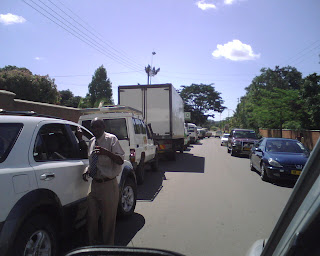
The practical side of the fuel shortage is that basic services are now being affected. The public transportation system is struggling to find fuel. People needing to travel to work are walking instead of driving and transportation of goods from one area to another is happening less. Today, lines of vehicles up to twenty cars long were lined up at all the fuel stations I passed with hope of a delivery arriving. No solid information, just rumors.


Thursday, November 26, 2009

Thanksgiving Turkey

Thanksgiving has been one of those holidays that we have celebrated sometimes while living overseas and at other times not.

For the last few years, we have tried to celebrate it in one way or another. Usually we have had chicken or ham, as turkeys can be hard to come by. This year will be different. A few weeks ago, one of our missionaries acquired some turkeys and has been feeding them in preparation for the holidays. One is ready this week. He’ll be on the table Saturday.

We call him Tom. He's free range, organic, fresh, and all that other stuff.

Monday, November 23, 2009

Being Thankful

A culture of entitlement makes it difficult to be thankful. I take what I have for granted, I believe that much of what I have I deserve or that it is my “right” to receive the things I have. Marketing gurus tell me that “I deserve a break,” because I have obviously been doing something difficult.

I was reminded the other day in a conversation about the uniqueness of our times. At no other time in history have as many people lived as comfortably and generally well off as the present. For most of history, the average person has lived much like the average person lives here in Malawi. Much of life is focused on survival. Obtaining and preparing food is a major feature of the day as well as acquiring water. Education, having more than two or three sets of clothes and durable shelter are considered luxuries.

I think that much of what we take for granted as “normal” is really not normal for much of the world, nor has it been normal in history. I think that our lack of exposure to the realities of the world or lack of reflection on these realities lull us into a false sense of normalcy. We don’t tend to be thankful for things we consider normal.

I don’t thank God for the glass of clean water I am drinking because I can access it from the convenience of my tap any time I want. I don’t thank God for my basic education because everyone I know has had the same opportunity. I am no longer thankful for my clothes because my closets are full to the point of needing to regularly sort and dispose of articles no longer being worn. My car is not a blessing because it consumes too much fuel and needs regular maintenance.

We need to practice the art of being thankful. As we celebrate Thanksgiving this week, why not take some time to deeply reflect on God’s goodness. Step back from your situation enough to get perspective on the many ways you have been blessed.

Thankful for family and opportunities to serve and a couple of hundred other things,

Ryan

Tuesday, September 8, 2009

What can you get for $1.38?

I am in the village of Chinseu, basically in the middle of nowhere. We arrived at the village after a 45 minute drive of ups and downs on a twisty dusty road better suited for one way traffic than two. Maneuvering through rocky parts of the road and concentrating on passing over narrow bridges built of stone or wood were included in the journey.

Even though we had to do various things in preparation for today’s seminar, we first went to the resthouse. It is important to check into the resthouse early to reserve your room. On any trips like this into rural areas, I have learned to bring a number of items that often prove very helpful. These include some basic tools, a mosquito net, a travel pillow, a towel, flip flops, headlamp and a tent. There are different reasons that I carry each of them. The tent is because sometimes the room that you booked at the local resthouse two weeks earlier gets given to someone else passing through.

The resthouse we’re at has two room options. The first is $1.03 a night and the second is $1.38 a night. We are told the difference between the rooms is the thickness of the mattress on the beds. We take five small rooms. Three of the more expensive rooms are available as well as two with the thinner mattresses. After some shuffling around, I end up in one of the more expensive rooms. So, what do I get for my $1.38? I have a bed with a lumpy mattress through which I can feel the cross beams of the frame, questionable sheets that I am told have been washed, a locking door with key, a single window with burglar bars, a mosquito net with more holes than net, a light bulb and a slightly funky smell. I’m actually quite happy. It is better than I expected. The locking door, burglar bars, and light are all bonuses I wasn’t necessarily expecting. There is a single toilet and “bath” shared between eight rooms. The toilet is a hole in the ground with a concrete cover and the “bath” is a small concrete room with a bucket in the middle. It is clean compared to most I have been in and recently painted.

After confirming that we were in fact here, and were in fact going to spend the night, we wandered off to the venue for the seminar. There is a community hall that World Vision constructed. We can use it free of charge, but have to pay $6.90 for someone to clean the toilets. We find the hall in a bit of a state of chaos. Chairs and building materials are spread around. After some discussions, we are told they will begin cleaning at 5:00 in the morning and it will be ready be the time we arrive at 7:30 for set-up. This is the reason we go a day ahead of time to set-up for seminars. Communication can happen on the phone, but nothing replaces face to face communication here.

We are met by the pastor that is the chairman of the local Pastors Fraternal (a group of pastors that meet monthly to discuss issues and encourage one another). They are hosting us for the meeting. It has been their responsibility to publicize the seminar. We meet with another man that is responsible for supplying soft drinks and then we go to the restaurant that will be supplying the food for lunch. Many details of how much food needs to be prepared and how it will arrive at the venue are discussed. It is near dinner time, so we also order our meal ahead of time.
My meal tasted of mosquito repellant. I had applied it not long before eating my nsima (local staple food) and chicken by hand. It added a tangy chemical taste for the first few bites. The meal was by the light of a kerosene lantern. Returning to my room I quickly made a cocoon of my mosquito net to hide from the swarm of mosquitoes that call my room their home. I began to do some work on my computer, but found my thinking getting fuzzy and my eyes closing. Apart from some vague memories of people talking much too loud outside my room and a constant shifting because of the wood cross beams below my mattress I was awoken at 5:00 by a knock at the door and the announcement of “madzi” or “water” letting me know that there was some warm water waiting for me in the “bath room.”

We are told 200 church leaders should be coming this morning to learn about how to share with their Muslim neighbors. We’ll be happy if half that number arrive.

Friday, August 21, 2009

Justice and Injustice

When we hear the word justice we usually think of a legal system. We link it to the idea of fair treatment, but usually in the context of a court room or when we come in contact with the law (such as how a police officer treats us).

In recent years, justice has become a topic being discussed by many within the church (largely the church in the west). It typically seems to be younger (20’s, 30’s) Christians talking about it and raising it up as an issue for the church to engage in and address. Some have struggled to know what is being talked about because the “justice” being discussed does not seem to be the idea of “justice” that they have known. In order to understand what is being discussed we need to understand justice in broader terms than how one is treated within a system of law.

Justice can be simply defined as “moral rightness” (Wikipedia). To broaden things more, many within the church discussing “justice” are often referring to “social justice.” Social justice can be defined as “a society in which justice is achieved in every aspect of society rather than merely the administration of law (Wikipedia).” So, justice is achieved not only in the courts, but all levels of society. Equal rights and opportunities are spread throughout.

So, how does this broad idea of justice impact ones thinking about the role of the church in society and the world? Consider the following:

· Thousands of children die each minute of preventable diseases that we have the means to stop, but we don’t spend the money to do it.
· Millions in the world are dying of starvation while others are dying of gluttony.
· Millions have less to live on each day than others spend on a cup of coffee. Others have more individual wealth than whole countries.
· There are more people in slavery today than in the worst days of the pre-abolition slave trade.
· Millions live as refugees from wars. (the idea of this list from; The God I don’t Understand, Christopher J. H. Wright)
· More than a billion people worldwide do not have access to clean drinking water.

When confronted with these kinds of issues, a broader definition of justice asks the question, “Is this right, is this fair, is this just?” The answer is “no, it’s not fair." The next question then is, “What should the church do about it?” The response is, “The church should engage in providing for the widow and orphan, defending the weak and being a voice for the voiceless.”

What do you think about this broader definition of justice? Should the church be worried about these kinds of issues? If so, to what extent should the church engage? What about our own personal responsibility? If I know injustice is occurring, am I responsible to do something about it? If so, does geographical distance matter or is my knowledge of the problem sufficient cause to call me to responsibility?

Thursday, July 16, 2009

Life's Events

One of the advantages of being a long-term missionary in the same country for a number of years is that you get to share in the lives of people, see them change and grow and participate in their major life events. A couple of weeks ago, I got to participate in the ordination of one of the younger leaders in the Africa Evangelical Church (AEC).

As I sat with the other pastors who had come for the event, my mind wandered back to my first hearing of the name Kondwani. I remember one of my missionaries talking about one of the youth in his church that had a lot of potential. He was encouraging him to go to Bible College. I remember not long after seeing his application for a scholarship. I remember the letter of recommendation from his local church and his track record of getting involved with his church. I remember various conversations with him in his last year of school as he talked about what he thought the church in Malawi should look and act like. I remember his graduation. I remember conversations about him possibly helping our Hope for AIDS program and when he first started working in it. I remember his wedding and Heidi and I being asked to lead in the procession to the reception. Faith was a flower girl. I remember receiving the news that Kondwani and Madalitso had a child. Now he was being ordained as a pastor. Cool.

The ceremony was like a regular Sunday service (hymns, prayers, sermon), but with some extra pieces. There was a formal time when the General Secretary of the AEC followed a program from a book that has outlines and wordings for such special occasions. Then there was the laying on of hands by the pastors that had gathered for the occasion (about ten) and prayer. A few of the pastors were asked to give words of advice. My two words were to remain humble and to be approachable (two problems areas that I see among some of the pastors I know). At the end Kondwani was given a white collar. The roots of the AEC are inter-tangled with the large Church of Central Africa Presbyterian (CCAP) which uses white collars as well. The collars are used on special occasions like weddings and funerals.

After the service, food was served. I was taking advantage of all the people gathered to catch up with various people I don’t see often. It made me late to arrive for the food. As I approached the pastors’ table I found the last plate of food. I was happy to find a chicken leg and ate the rice and accompanying sauce. Most of the pastors were finishing and began to disperse. Then it arrived, the special plate; liver and goat lung. The pastor nearest me apologized that I had found the last plate and insisted that I be the first to help myself to the special pieces. I smiled and accepted a small piece of liver. He began to insist I take more, but the thought was quickly overtaken as spoons appeared from all around as the dispersed pastors quickly assembled again to take part.

While goat organs may not be my favorite food, the opportunity to participate in someone else’s life like this is well worth it.

Saturday, July 11, 2009

Seeing the world through another's eyes

Our view of life or our perspective has a huge impact on how we feel about life. It affects whether we are happy, satisfied, content or unsatisfied and anxious or worried. It is easy to get so focused and wrapped up in our own circumstances that we only see things from our point of view. Every once in a while we need a good reality check. Seeing life through someone else’s eyes can help put our perspective in check as we recognize that our worries and concerns look quite trivial when compared to others.

A couple of weeks ago I met Jameston. He is one of the students benefitting from a secondary school scholarship program that is part of our orphan care program in Nathenje. As we unpacked his story I became unsettled. I was reminded of the very basic problems that many Malawian struggle with daily and the impact that even a small amount of assistance can make. I know the tough realities of life here, especially life in the village, but each time it is personalized as I stare someone in the face telling me about their life I find myself trying to crawl into their shoes to see the world as they do. I am not sure if I would have the same positive perspective on life as Jameston if I was forced into similar circumstances.

Jameston’s father passed away in 2004. Since that time, he has been the main bread winner in his family. He tries to provide for his mom, and four other siblings as well as go to school. He works odd jobs such as helping others prepare their fields for planting, weeding, digging as well as harvesting. This seasonal work only helps for part of the year. The government assists one of his brothers with school fees, but an over stretched government is only able to help one child per family. In January of this year Jameston had to drop out of school because he could not find money enough to both assist the family and pay school fees. This is where our program came in. Jameston was happy as he told us that now that his school fees are covered and he has a uniform, shoes and notebooks his worries are much less. He just has to look for money to help the family eat.

It is humbling to talk to someone whose primary concerns are so basic and they are grateful for the difference a bit of assistance is making. I wonder if I would see the world as full of potential. When asked what he wants to do after school, Jameston responded, “I want to be a lawyer.”